
Design does not begin with finishes, furniture, or floor plans. It begins with people.
In the second article of my Design as Applied Intelligence series, I share how my work is rooted in understanding how clients actually live and work, often beyond what they’re able to articulate themselves. When design responds to real behavior instead of idealized use, spaces feel intuitive, supportive, and quietly transformative.
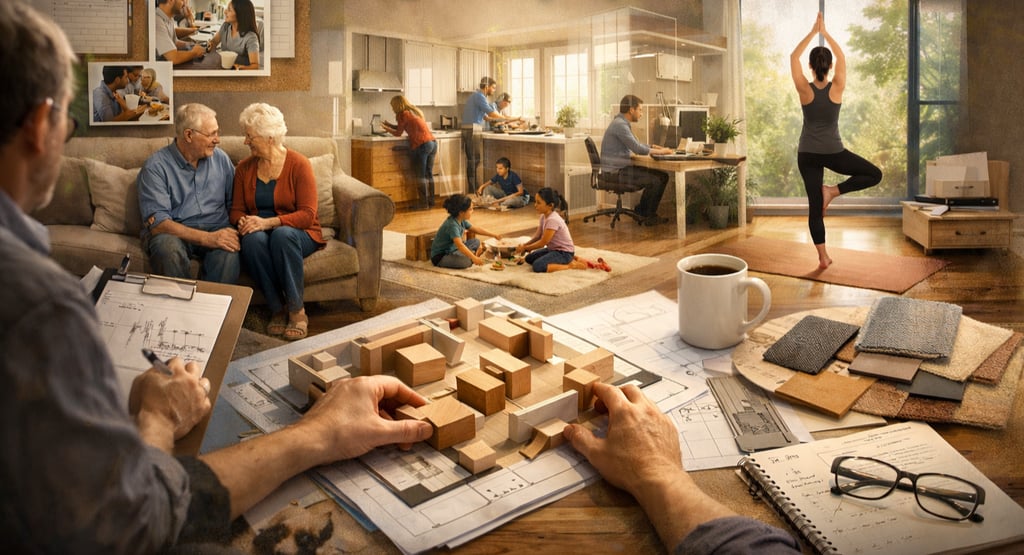
How I design is in direct relationship to how my clients live and work, often articulating solutions they haven’t yet been able to fully articulate themselves. My role is not to impose an aesthetic, but to observe patterns, ask meaningful questions, and translate lived experiences into environments that foster ease of use and quality of life.
When that translation is done well, design feels intuitive. When it isn’t, even the most beautiful space can feel inefficient, misaligned—just off.
Understanding Before Designing
Clients often arrive with a familiar list of requests: more storage, an open concept, better flow, a home office that works. But beneath those stated needs are unspoken behaviors shaping why the space isn’t functioning as intended.
Design becomes most effective when it responds to how life is actually lived, not how it’s idealized.
To get there, I look beyond what’s being asked and focus on what isn’t:
Is this a busy household or a fast-paced lifestyle that requires efficiency and momentum, or a slower, more self-paced rhythm?
Do the occupants need visual calm or stimulation?
Do they host, retreat, multitask, or compartmentalize?
How do they move through their day, and where does friction quietly appear?
These patterns matter more than square footage or style preference.
Lifestyle and Work Are No Longer Separate
The line between residential and commercial design has blurred. Homes now function as workplaces. Offices are expected to feel humane and spaces in general are being asked to do more with fewer boundaries and higher expectations.
This shift requires designers to think systematically:
How do people transition between roles throughout the day?
Where does work end and rest begin—or does it?
How does a space support focus without isolating?
How does it encourage connection without creating noise?
Does the design remove constraints for optimal use or is it simply visually appealing?
Aesthetic design absolutely matters. It can elevate mood, identity, and wellbeing. But aesthetics and function must coexist. When one is prioritized at the expense of the other, spaces may look complete yet fail to actively serve the people within them.
Designing without acknowledging these realities often results in environments that feel perpetually “off,” even if no one can quite explain why.
Ease of Use Is a Design Metric
Ease of use is often invisible, but its absence is immediately felt.
Spaces that function well:
Reduce unnecessary decision-making
Support routines without conscious effort
Adapt as life and work evolve
This is where thoughtful space planning becomes an act of care. How people move through a space, where things naturally land, how light supports daily rhythms, these choices determine whether an environment works with its inhabitants or quietly works against them.
The Designer’s Role as Interpreter
Clients are experts in their own lives, but they are not always experts in translating that knowledge into spatial decisions. This is where my role becomes interpretive. I listen for what’s said and what isn’t. I observe habits clients take for granted and notice friction they’ve normalized over time.
Design becomes a process of decoding:
Turning routines into layouts
Turning pain points into opportunities
Turning lived experience into spatial clarity
This work requires restraint as much as creativity. Often, the smartest design choices are the quietest ones; ones that don’t announce themselves but feel undeniably right. The space just simply works.
Designing for Longevity, Not Performance
Spaces designed around real behavior age better because they remain functional as life shifts and evolves over time. When design prioritizes ease of use and quality of life, it stops performing for an audience and starts serving its inhabitants.
Design That Works Feels Natural
The most meaningful feedback I receive is not only about how a space looks, but how it feels to live or work within it:
“It just makes sense.”
“Things flow better now.”
“We didn’t realize how much stress this space was causing.”
Those responses signal that the design is doing its job, quietly, consistently, and intelligently.
At its best, design is an act of understanding and translating that understanding into spaces that support life as it is actually lived. Ultimately, that is how I measure my success as a designer.